

Price LSA management around the work you agree to deliver
Price Local Services Ads management from your cost to serve the client and the scope you agree to deliver. Account for staff time, operating costs, onboarding and support before choosing a flat fee, a spend-based fee or another structure. Show your agency fee apart from Google's advertising charges, and name who handles incoming leads and account decisions.
Start with three separate amounts: the client's Google advertising charges, your agency service fee and your cost of delivering that service. Your quote should explain the work behind the fee, including the response coverage the client must provide.
Jump to the scope worksheet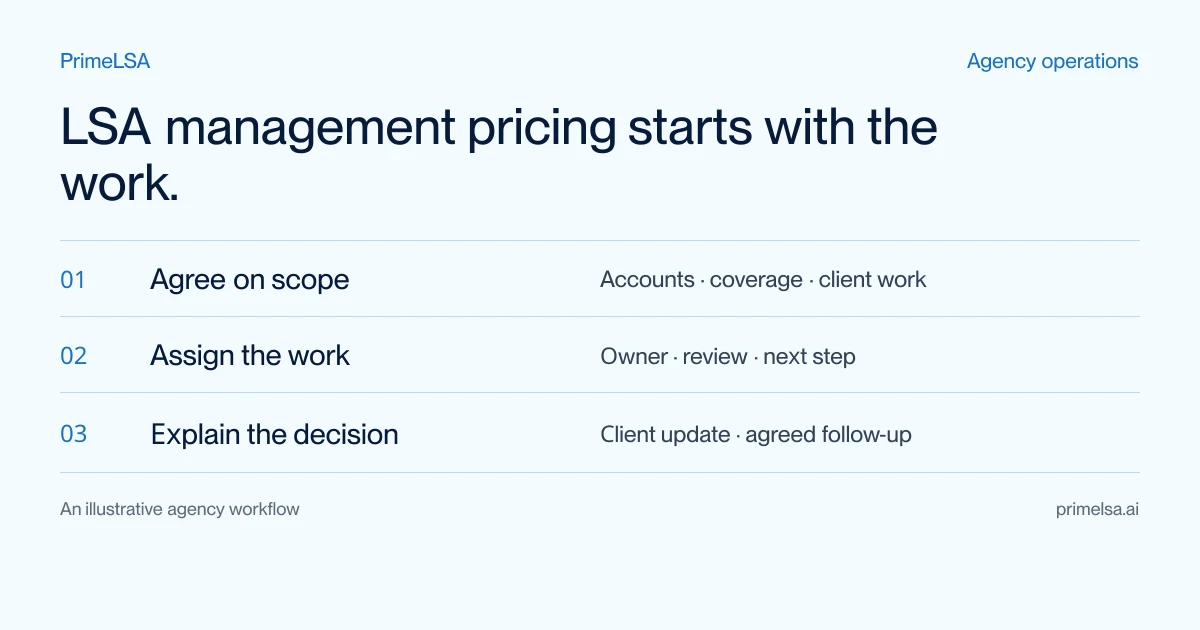
Set responsibilities before you quote
Write down what one client will receive before choosing a fee. Two clients with the same Google budget can need different levels of account review, lead follow-up and reporting. Review their account structure, available records and operating coverage during onboarding.
Use this worksheet to assign the work. Replace the example scope with your own quantities and review frequency. Name the client contact who can supply missing information or approve a change; an agency cannot complete that part of the process on its own.
| Work to price | Scope to record | Owner and dependency | Completion evidence |
|---|---|---|---|
| Connection and verification | Accounts, locations, access checks and agreed follow-up | Agency coordinates; client supplies documents and permissions | Confirmed access and outstanding requirements |
| Visibility and account review | Review frequency, accounts and follow-up included | Agency LSA lead; authorized user approves account changes | Dated account note, next step and owner |
| Calls and lead quality | Available recordings, review sample and escalation scope | Agency reviews records; client confirms booked-job outcomes | Call or lead review with follow-up assigned |
| Message response and handoff | Enabled workflow, coverage, exceptions and handoff | Agency configures the agreed workflow; client handles the next step | Available response and handoff record |
| Reviews and profile context | Observation and agreed client follow-up | Agency reviews context; client owns business facts and service delivery | Review or profile note with a named action |
| Reporting and client meetings | Period, recipients, meeting time and format | Agency account manager; client supplies downstream outcomes | Delivered report and decision record |
| Branded client access | Domain, presentation, users and onboarding | Agency and PrimeLSA complete the partner setup | Client view and permissions confirmed |
Complete your offer with an included quantity, review cadence, response contact and additional-work rule. The rows describe work you can scope; they do not promise approval, bookings or credits.
Choose how you charge for LSA management
Choose a structure your team can explain and deliver. Compare the units you bill with the work in the worksheet. Keep staffing, client communication and exception handling in the calculation, even if you use the same fee model across your agency.
Flat monthly fee
Use one fee for a defined set of accounts and recurring work. Name the review cadence, client communication and response coverage in the agreement. A clear allowance for meetings and exception work helps your team keep the promised service within scope.
Record the account limit and the additional-work rule.
Fee per account or location
Choose the unit that matches the work. One client may have several Google accounts, and one account may involve more than one operating location. A service area is not a separate account. Check access, reporting and response ownership before applying a per-location price.
List the client, Google accounts and operating locations.
Percentage of Google ad spend
Define the spend basis, minimum fee and treatment of credits before the first invoice. A larger budget may require more attention, but spend alone does not describe the work: a low-spend account can still need verification follow-up, call review and client meetings.
Agree on the reporting period and reconciliation terms.
Setup fee plus ongoing management
Separate connection, permissions, onboarding and verification coordination from the recurring service. Document what the setup fee covers and when the ongoing fee starts. Your team can coordinate the process; Google controls verification decisions and approval.
Keep setup tasks and recurring delivery costs separate.
Base service with scoped additions
Start with an agreed recurring service, then price extra accounts, extended response coverage or more reporting work when the client requests them. Name the additions and get agreement before work begins. These are agency package choices, rather than universal LSA plan tiers.
Describe each addition with a quantity, owner and fee.
Calculate your delivery cost and margin
Calculate the recurring cost of serving one client. Use a loaded hourly cost that reflects the staff costs you intend to include, then add operating and support allocations that sit outside those hours. Avoid counting the same support work twice.
Hypothetical agency example. These figures are not PrimeLSA prices or market benchmarks.
| Monthly delivery input | Example |
|---|---|
| Agency service fee | $800 |
| Staff time: 4 hours × $60 loaded hourly cost | $240 |
| Allocated operating costs | $120 |
| Support allowance | $80 |
| Total modeled delivery cost | $440 |
| Contribution after modeled delivery cost | $360 |
| Delivery contribution margin | 45.0% |
Modeled delivery cost = staff hours × loaded hourly cost + operating costs + support allowance.
Delivery contribution = agency service fee − modeled delivery cost.
Delivery contribution margin = delivery contribution ÷ agency service fee.
The 45% margin is an assumption for this example. It describes contribution after the modeled delivery costs, before business expenses those inputs omit. It is not net profit or an industry target.
Margin and markup use different denominators. The $360 contribution divided by the $800 fee is a 45% margin. Dividing the same $360 by $440 of modeled cost gives an 81.8% markup. Use the right measure when comparing packages.
Keep onboarding separate. For example, three setup hours at $60 plus $40 of other setup costs total $220. A $400 setup fee would produce the same assumed delivery margin. Your actual setup tasks and costs will differ.
Review your fee when the client adds work
A client might add an account, request after-hours response coverage or ask for a longer reporting meeting. Review the extra work before treating it as part of the existing retainer.
The same hypothetical $800 monthly fee, with three extra staff hours at $60.
- Modeled delivery cost
- $440$620
- Delivery contribution
- $360$180
- Delivery margin
- 45.0%22.5%
At $620 of modeled delivery cost, retaining the assumed 45% margin would require a fee of $1,127.27, or $1,128 rounded up to whole dollars. The formula is modeled delivery cost ÷ (1 − chosen margin). Use it to examine your own scope and costs, rather than adopting the example as a recommended rate.
Record the request, the added work and its owner. Update the scope and confirm the revised fee with the client before starting. A change in ranking alone does not define additional work or justify a new charge.
Build your agency package with Advantage
With white-label Advantage by PrimeLSA, your team can review client LSA accounts and present the work through your agency brand. Use ranking and visibility context, calls, replies, reviews, lead quality and account health to decide what to check and explain the next step to the client.
- 01 / Account reviewReview response coverageUse available call, reply and account context.
- 02 / Agency next stepConfirm the follow-up ownerRecord who will check the issue and approve the next action.
- 03 / Client updateExplain the decisionShare the review and agreed follow-up through your agency presentation.
Review the account and agree on the next step
Your team can start with the client portfolio, open an account and review visibility alongside calls, replies, lead quality, reviews and account health. Use the available history and account context to decide what needs attention. Record the next step and who will review or approve it.
Review multiple client LSA accountsDefine response and reporting coverage
Include the call analysis, configured message workflows, human handoff and lead-feedback review your agency agrees to provide. Set reporting periods, recipients and follow-up ownership. Advantage supports client updates with the available account figures and notes; ask the client to confirm qualification and booked work when those outcomes sit outside the account.
Explore client-ready LSA reportingKeep your agency in the client relationship
White-label Advantage supports agency presentation through a branded domain, logo, login, supported emails and authorized client access. Your agency defines the client package and pricing under partner terms. PrimeLSA supports the product and partner setup; your team assigns account work and manages the client relationship.
See Advantage account intelligenceDefine the enabled features and coverage during partner setup. For example, call analysis reviews available records, while configured message workflows handle the agreed response path. Analysis access and enabled actions have different responsibilities. Keep an agency owner and a client handoff contact in the service scope.
Keep the lead-review task distinct from a refund promise. Your team can review lead feedback and credit status; Google determines credit outcomes under its rules. Price the work your team performs and confirm any separate managed support in the agreement.
Explore white-label AdvantageShow Google spend and your fee on separate lines
Explain the payee and purpose of each amount in the proposal. Google requires third parties to disclose management fees before the first purchase and on customer invoices, and to distinguish their fees from the Google costs they report. Google third-party transparency requirements.
Hypothetical client reconciliation, USD. Not a PrimeLSA quote.
- Client pays Google Advertising charges
- $2,500
- Client pays the agency Agreed management service
- $800
- Total planning outlay
- $3,300
Before any applicable taxes or other agreed costs.
In this example, Google bills the client and the agency invoices its own $800 fee. The $3,300 figure is a combined planning total, not an agency invoice for Google's charge. Name any different billing arrangement in the agreement.
Google's advertising charge and your delivery margin answer different questions. Use a consistent definition when discussing Google's cost per lead, qualified opportunities and booked work in the client report.
Questions agencies ask about LSA management pricing
How much should an agency charge for LSA management?
Choose a fee from the work you agree to deliver, your costs and your intended delivery margin. In the hypothetical example above, an $800 fee covers $440 of modeled monthly costs and leaves $360 before costs outside the example. Use your own inputs before quoting a client.
Does an LSA management fee include Google's advertising charges?
Your agreement should explain who pays Google and what the agency charges for its service. In this guide's example, the client pays Google for advertising and receives a separate agency service invoice. Keep the two amounts distinct in proposals and reporting.
Is a flat fee better than a percentage of ad spend?
A flat fee suits work with a clear scope. A spend-based fee can fit an agreement that defines its billing basis and minimum. Compare the staff time, accounts and response coverage you must supply; the client's ad budget alone does not describe that workload.
Should we charge an LSA setup fee?
Price the connection, access checks, verification coordination and onboarding work your team will perform. Explain which tasks belong to setup and which belong to the ongoing service. Confirm the fee with the client before starting; Google controls its verification process and approval.
Should we charge per client, account or location?
Name the unit in the agreement and list what it includes. One client can have several Google accounts or locations, and a service area does not equal a separate account. Review access, reporting and workload before deciding how to price the arrangement.
Can an agency charge a fee per LSA lead?
An agency can propose a defined per-lead service fee, subject to applicable terms and clear disclosure. Define the lead and reconciliation rules in the agreement. Google's charge status and credits do not establish whether a lead became qualified work or a customer. Keep agency fees separate from Google charges.
Can we set our own prices with white-label Advantage?
Yes. Your agency can define its client-facing package and pricing under the selected partner agreement. Review platform costs, usage, billing responsibilities and included features during setup. The hypothetical service fees in this guide do not describe PrimeLSA's prices.
Does white-label Advantage include a team that runs our clients' accounts?
The white-label offering provides Advantage through your agency presentation with the features and support in the partner agreement. Your agency manages the client relationship, defines its service and assigns account work. Confirm any managed support as a separate agreed responsibility.
Does paying an agency a higher fee guarantee better LSA rankings?
An agency can charge for account review, response work, reporting and other agreed services. Google controls the LSA auction. Compare the work and evidence behind the offer rather than treating a higher fee as a promise of a particular position.
Should our fee depend on the number of credits we recover?
Define the work you will perform rather than promising a refund total. Google uses automated lead-credit review with eligibility limits. Record the lead feedback and credit status available for the account, and describe any reconciliation terms in the client agreement.
Review your white-label LSA setup with PrimeLSA
Bring your client-account structure and proposed service scope. Review Advantage's agency branding, enabled features, client access and partner setup with the PrimeLSA team.