

Account reference
Start with the account record before scaling leads.
Google's current United States list includes plumbers. It also lists drain expert in California and Florida and sewage system as separate categories. A business should confirm the precise services available in its market because one plumbing selection may not cover every job.
Licensing and insurance requirements can vary by state and locality. Keep the legal business details, documents, expiration dates, profile services, and advertised territory consistent with the work the company is authorized and equipped to perform.
Plumbing intake must turn symptoms into a dispatch decision
The call handler needs the service address, the active symptom, when it began, whether water can be shut off, whether sewage or electrical hazards are present, and whether the caller can authorize work. Those answers determine urgency and the right technician more reliably than a generic request for plumbing help.
After-hours coverage needs a defined handoff. An answering service that only takes a name and number may be too slow for an active leak, while a dispatcher who promises every caller immediate service can overload the field team.
- Confirm address and service-area fit before promising arrival time.
- Distinguish active emergencies from estimates and future projects.
- Route water-heater, drain, sewer, leak, and installation calls to the right skill set.
- Track missed calls, callback time, booked window, and completed dispatch.
Plumbing lead value changes with the job and the dispatch
A backed-up sewer, burst pipe, water-heater replacement, leak investigation, and fixture installation do not carry the same urgency or job economics. The lead cost only makes sense beside the booked-job rate, average ticket for that service, technician time, parts, drive time, and the chance of a return visit.
Dispatch capacity can be the real limit. More calls add little value when every nearby technician is committed, the remaining appointment window is too far out, or the caller sits outside a profitable route. Compare service type with territory.
- Separate emergency work from scheduled repair and installation.
- Track booked jobs, completed jobs, average ticket, and gross margin by service type.
- Record drive time and technician availability for outlying service areas.
- Identify repeat callers, warranty work, and existing-customer support before judging lead quality.
Which plumbing LSA outcomes should dispatch review?
A plumbing dispatch scorecard should go beyond one lead total. Record the service address, problem type, urgency, answer outcome, promised arrival window, technician assignment, completed work, and final job value. The resulting trail shows whether the account attracted the wrong work or the operation could not serve the right work.
Compare emergency and scheduled calls in separate lanes. A missed burst-pipe call and an unbooked fixture estimate reflect different customer timelines, staffing needs, and recovery options. The same rule applies to drain, sewer, water-heater, leak, and installation demand.
- Answered live, missed, voicemail, answering service, or transferred call.
- Emergency, same-day, scheduled repair, estimate, or unsupported request.
- Inside territory, outside territory, or inside territory without open capacity.
- Booked window, dispatched technician, completed job, cancellation, or no-show.
- Job value and service type connected to the original inquiry when records permit.
A weekly plumbing LSA review should start with dispatch exceptions
Pull the calls that did not become completed jobs and group them by operational reason. Separate missed or abandoned calls from answered calls, then mark service mismatch, outside area, unavailable technician, no appointment window, price objection, cancellation, duplicate, existing customer, and unresolved follow-up.
Compare those exceptions with advertised services and open routes. A cluster of unsupported sewer calls points to category fit. Serviceable emergency calls lost after hours point to coverage. Jobs booked but not completed point to dispatch or field capacity; ad visibility already produced the opportunity.
- Emergency calls missed before a dispatcher or technician answered.
- Serviceable calls declined because the schedule or skill set was full.
- Outside-area contacts generated from routes the team cannot cover well.
- Booked windows cancelled, rescheduled, or left without technician assignment.
- Calls that needed parts, equipment, or a service the company does not offer.
- One account or operating change to test against the next comparable week.
Weather and household timing reshape plumbing demand
Freezing weather can produce pipe failures, heavy rain can expose drainage problems, and hot periods can change water use. Holidays and weekends also matter because occupied homes create urgent calls when standard suppliers and staffing may be limited.
Build the calendar from local operating history. A cold-climate winter plan and a warm-market storm plan may require different hours, inventory, territories, and message coverage.
- Annotate freezes, storms, heat events, holidays, and major local disruptions.
- Confirm on-call coverage before opening more after-hours demand.
- Review parts and equipment constraints for seasonal job types.
- Tighten service areas when weather makes travel times unreliable.
Example: strong visibility, weak emergency booking
Consider a plumbing company that appears consistently and receives urgent evening calls, but the booked-job count does not rise. Split the calls into answered live, sent to voicemail, answered by a service, called back within the customer's decision window, outside territory, and unavailable technician type.
If urgent callers are lost before dispatch, raising budget adds pressure to the same break in the workflow. The first test may be tighter after-hours routing or a narrower service area, measured against booked and completed jobs.
- Planning scenario only; compare it with the company's dispatch records.
- Measure the path from first ring to completed job, not call volume alone.
A plumbing LSA workflow from urgent symptom to completed dispatch
The first useful decision is whether the caller has an active hazard, a same-day failure, a repair that can wait, or a planned installation. Dispatch then checks the address, technician skill, open route, parts constraints, and authority to approve work before promising an arrival window.
A completed review follows the path beyond the phone. The team records whether it booked the visit, sent the right technician, completed the job, or lost the opportunity because of territory, capacity, price, or follow-up. That record makes budget and service-area decisions easier to evaluate.
- Triage: capture the active symptom and immediate safety concern.
- Route: confirm address, coverage area, and available technician skill.
- Schedule: offer a realistic arrival window or a clear callback owner.
- Complete: record dispatch, diagnosis, completed work, and follow-up need.
- Review: compare lost jobs with call coverage, route capacity, and advertised services.
Plumber eligibility depends on category, market, and current credentials
Google's current United States list includes plumbers. It also lists drain expert in California and Florida and sewage system as separate categories. A business should confirm the precise services available in its market because one plumbing selection may not cover every job.
Licensing and insurance requirements can vary by state and locality. Keep the legal business details, documents, expiration dates, profile services, and advertised territory consistent with the work the company is authorized and equipped to perform.
- Check current Local Services Ads availability for each intended plumbing service.
- Keep requested licenses and insurance documents current.
- Do not select drain, sewer, or installation work the team cannot service.
- Recheck verification after ownership, address, or license changes.
Google Verified Local Services Ads for Plumbing Companies
Insights from Scaling and Managing 12+ Plumbing Companies
Did you know 80% of local searches convert into customers?
How Local Services Ads work for Plumbing Companies
Local Services Ads can place plumbing companies in prominent Google Search results and let customers call or message the business from its profile. Google says advertisers pay for leads related to the business and its listed services, rather than for an ordinary visit to the profile.
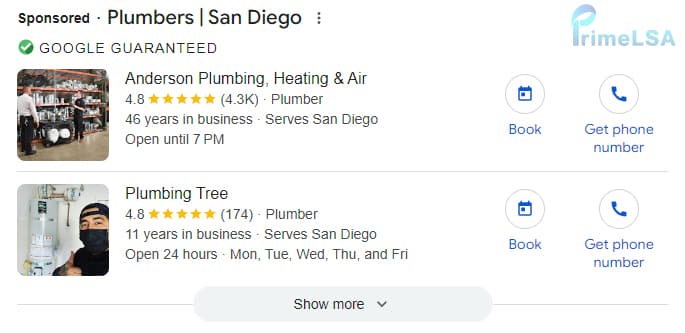
A plumbing company profile can show services, location coverage, reviews, business details, and available contact methods. Searchers may also filter providers by the specific plumbing services they need.
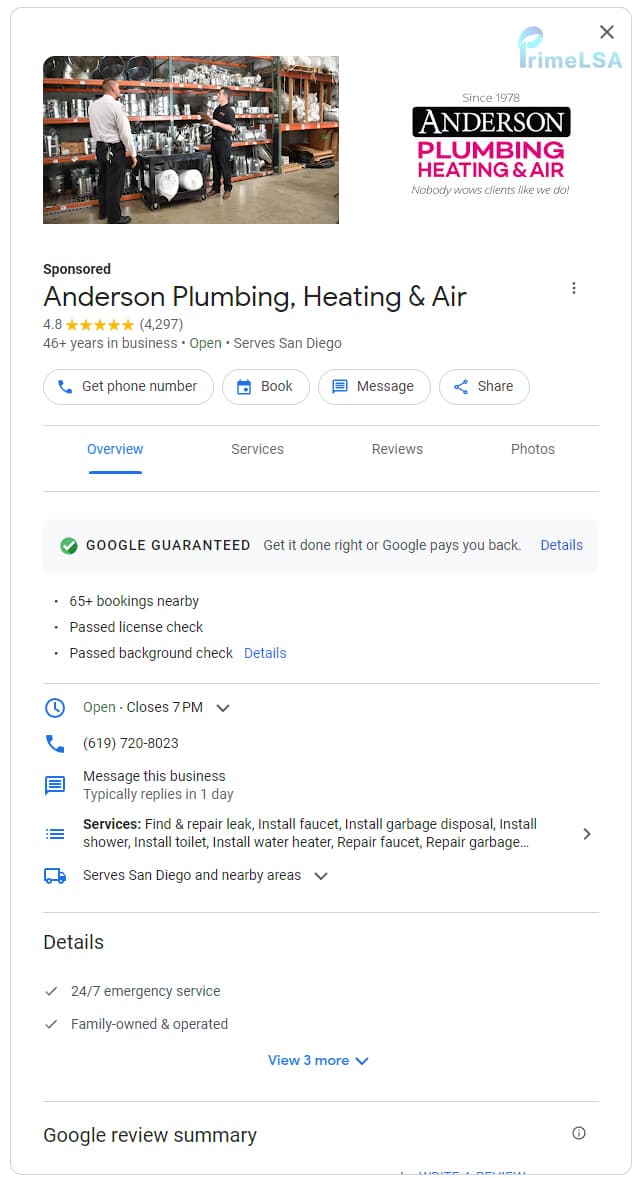
Google Verified, formerly Google Guaranteed
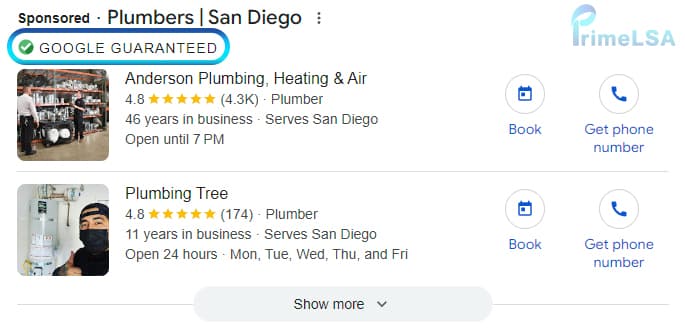
Google now uses one Google Verified badge for eligible Local Services Ads advertisers that complete the required screening and verification process. Google announced the transition in August 2025 and began replacing Google Guaranteed, Google Screened, License Verified by Google, and the Money Back Guarantee in October 2025.
For this category, Google Guaranteed is the former name many owners, searchers, screenshots, and older guides still use. The established page and terminology remain useful historical context, but Google Verified is the current badge.
Google's current Google Verified documentation says eligible existing advertisers transition automatically and the badge-name change does not affect Local Services Ads ranking.
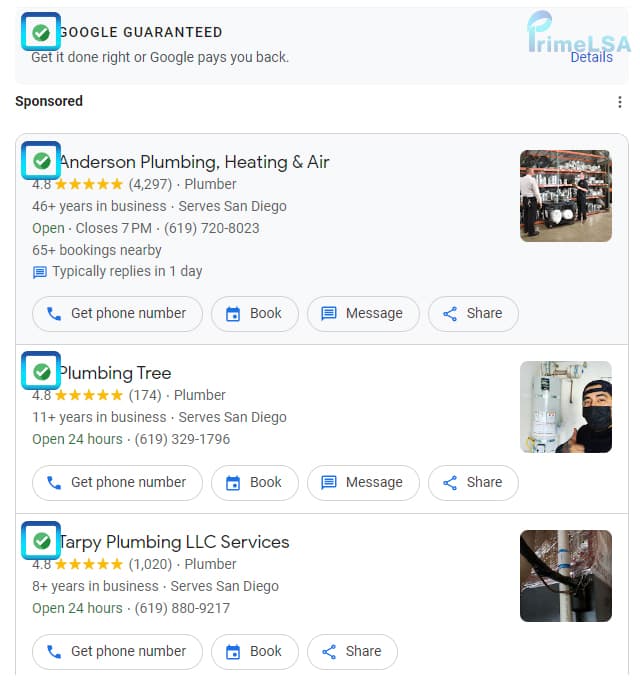
Google also discontinued the Money Back Guarantee. Its current documentation limits reimbursement requests to eligible services booked through Local Services Ads before December 7, 2025, subject to the stated submission deadline.
For the historical term and its earlier requirements, see the Google Guaranteed guide.
How plumbers can start with Google Verified Local Services Ads
Confirm current category and market eligibility on Google's Local Services page. Then complete the screening and verification steps Google requests for the plumbing company.
Match the service list and service area to work the business can actually accept. Decide who owns calls, messages, qualification, scheduling, and follow-up before increasing lead volume.
Budget examples from this page's original planning model
- Pay per contact: you pay when potential customers call or message your business, making budget review more tied to real lead flow.
- Estimate leads: if cost per contact is $10, a $500 budget can support roughly 50 leads.
- Adjust for success: a higher budget, such as $2000, can create more opportunities if the team can handle about 200 contacts.
Treat those figures as a planning example, then compare them with the plumbing company's actual lead charges, booked work, response capacity, and service mix.
Start driving more leads for your plumbing business today
If managing Local Services Ads feels overwhelming, PrimeLSA is here to assist. With over a decade of experience, we specialize in optimizing Local Services Ads to meet your specific needs.